Try not to look at the clock — that's the trick, or so you've read. So you don't, for a while. You lie there and listen to your own heartbeat and negotiate with yourself about whether this counts as sleep if you're not actually asleep. Eventually you look anyway. 2:47. Of course it's 2:47. It's always somewhere in that neighborhood — never a merciful 5am you could just get up and start the day from, always the dead middle of the night, with hours left to lie there doing math you don't want to do: if I fall asleep right now, I get four hours. Now three and a half. You don't fall asleep right now.
The next morning runs on fumes and caffeine, and that's the easy part to explain to people. Harder to explain: the word that isn't there. You're mid-sentence, mid-thought, and it's just gone — not on the tip of your tongue, not almost-there, gone the way a word is gone when you never learned it. You laugh it off in the meeting. You don't laugh it off in the car after, when the quiet thought shows up: is this just tired, or is this something else. You don't say that thought out loud. You Google it at a red light instead, which helps exactly no one.
“That's normal at your age.”
The trouble with asking around: everyone has an opinion, and no two of them agree. One friend swears by melatonin. Another says melatonin made it worse. Someone's sister-in-law takes 900mg of something at a dose her cardiologist recommended and felt nothing. A doctor, if you can get fifteen minutes with one, might say some version of “that's pretty normal at your age” and move on to the next thing on the chart. Normal isn't the same as fine, but it's treated that way often enough that you stop mentioning it.
So you try things. A 13-ingredient “hormone balance” blend with a proprietary formula and no doses listed on any single ingredient — because if you can't see the doses, you also can't see that most of them are token amounts. You take it for six weeks. Nothing. You try another one. Also nothing, or close enough to nothing that you can't honestly tell the difference from the placebo effect wearing off. The drawer where these bottles go to die gets fuller. Your skepticism, meanwhile, gets sharper — which, it turns out, is the correct response.
Skeptical? Good. Start with the label.
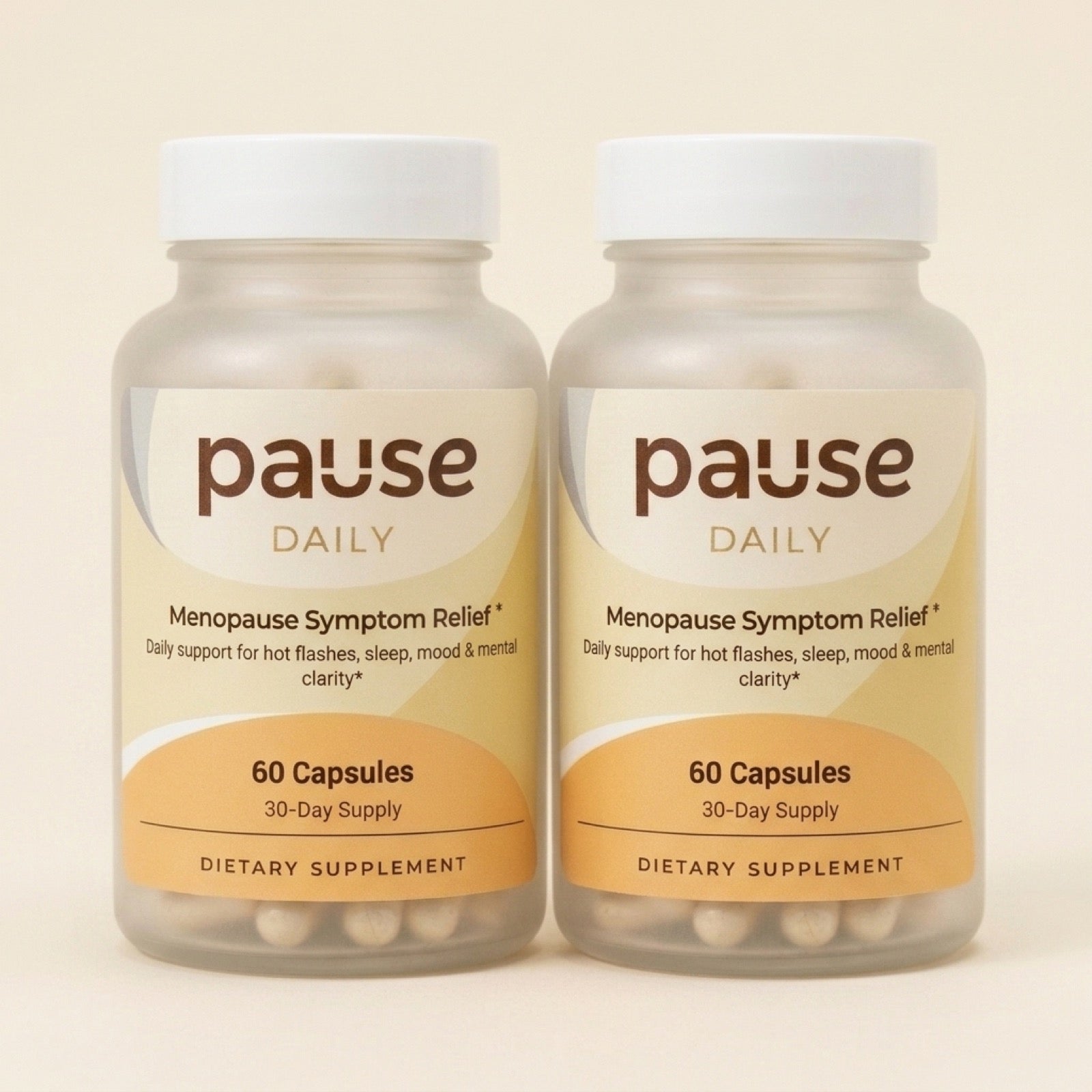
Two ingredients, both doses printed: Pueraria Mirifica 250 mg, L-Theanine 200 mg. No proprietary blend to take on faith.
See the whole labelIt's not in your head
Here's what's actually happening, in plain terms: as estrogen fluctuates and declines through perimenopause, it stops doing a job you never had to think about before — helping keep cortisol, your stress hormone, on a polite schedule. Cortisol is supposed to rise gently before dawn. Without estrogen's usual buffering, that rise can arrive earlier and sharper, landing right around 3am — which is also, unhelpfully, the lightest part of your sleep cycle. Your body reads that as an alarm. You wake up not just tired, but alert, keyed-up, doing math about hours of sleep at 3-something in the morning. We go deeper on this exact mechanism — and what honestly helps — in why you wake up at 3am.
The heat works on a similar glitch. Estrogen helps regulate your internal thermostat; as it swings, that thermostat gets twitchy and overreacts to nothing, launching a full-scale cooling response — the flush, the sweat — that's bigger than whatever tiny shift set it off. Which is also why the flush is so often followed by freezing: your body dumped far more heat than it needed to, and now you're damp and chilled in the sheet you just kicked off. Two different malfunctions, same underlying cause, and neither one is a personal failing or a sign you're somehow doing this wrong. We cover the flush-then-freeze pattern on its own in hot flash then freezing cold.
Built for exactly this pattern.
L-Theanine for the 2am racing mind, often felt in week one. Pueraria Mirifica for the deeper swing, building over weeks 3–8.
Choose your packWhat honest support actually looks like
This is the part where most products in this category oversell. We'd rather undersell and over-deliver, so: Pause Daily is two ingredients. Pueraria Mirifica at 250mg, L-Theanine at 200mg — both doses printed on the label, not folded into a blend you have to take on faith. L-Theanine tends to work fast; calmer evenings and less 2am racing mind, often within the first week. Pueraria Mirifica works slower, because that's how it actually works — most women notice hot flash and night sweat changes somewhere between weeks 3 and 8, not on day one. Any product promising overnight relief from a plant compound is telling you something about their marketing, not their science.
You take the 60 days. We take the risk.
Because that timeline is real and it's longer than a week, we built the guarantee around it: 60 days, not 30. Take Pause Daily as directed, and if your nights, your temperature, or your head don't feel meaningfully different, email us and we refund every cent. Keep the bottle. No return label, no forms, no call center trained to talk you out of it. You take the 60 days. We take the risk — which is exactly how it should work when a company is confident about what's on its own label.
“I'd wake up around 2–3am and couldn't fall back asleep.”
“I'm at the point of not caring whether hrt is good or bad… I just want to feel like me again.”
Under a dollar a day, for the version of you that sleeps
The 3-bottle pack works out to under a dollar a day, ships free, and comes with Luma, our drug-free sleep diffuser, at no charge. None of that matters, though, if the product itself doesn't hold up on your specific 2:47am. So we built the guarantee to remove that risk, and we built the label to remove the guesswork. What's left is just: try it, honestly, for the weeks it actually takes.
Tonight could still be a 2:47am. But it doesn't have to be every night, forever.
Pause Botanica is a Canadian company dedicated to women's hormonal health — the stretch of it nobody hands you a manual for.
Pause Daily didn't start with a formula looking for a market. It started with 31,000+ comments pulled from public menopause communities — what women were actually saying, in their own words, about their own 2:47ams. The product came after, built to answer what was actually being asked instead of what was easiest to sell.
That's the same instinct behind the label itself: two ingredients instead of thirteen, both at full dose, and a 60-day guarantee instead of a 30-day one. Different decisions, same rule — only promise what you're willing to stand behind.